
- Nonwoven Fabrics
- Tailor Made Masterbatch
- Plastic Masterbatch
- Chemical Fiber Masterbatch
- Functional Masterbatch
- Machinery
- Spunbond PP Nonwoven Masterbatch
- Mono Color Masterbatch
- Liquid Color Masterbatch
- Non-woven Masterbatch
- Polyester Fiber Masterbatch
- Nylon Fiber Masterbatch
- Polypropylene Fiber Masterbatch
- Lab Nonwoven Machine
- Lab BCF Machine
- Dryer
- Filler Masterbatch
- Rapid Pressure Rise of Polyester Spinning Pack: How to Evaluate Dispersion Performance of Polyester Fiber Masterbatch
- Batch‑to‑batch Color Deviation of Colored Polyester Yarn: Easily‑ignored Carrier Compatibility of Polyester Fiber Masterbatch
- How Can Mono Color Masterbatch Adapt to Different Plastic Applications? Key Factors from Color Stability to Processing Efficiency
- Functional Masterbatch Development for Nonwovens: What Does the New Anti-Slip Technology Indicate?
- Peak Season for Plastic Processing in Golden Autumn|Yantai Liangcai Plastic Technology Co., Ltd.: Mono‑color Masterbatch Supports Flexible Color‑matching Production
- Plastic Processing Shifts to Multi‑variety & Small‑batch Production, Mono‑color Masterbatch Shows Industrial Value for Flexible Color Matching
- Mobile: +8613430333258
- WhatsApp: +8613430333258
- Email:wendy@ytlc-colour.com
- Address:DALAN INDUSTRIAL PARK, ZHANGXING TOWN, ZHAOYUAN CITY, SHANDONG, CHINA
In the production process of plastic products, Mono Color Masterbatch is a common coloring material. It is made by mixing a high proportion of pigments or dyes with carrier resin, and then through heating, dispersion, cooling and granulation. Compared with directly using color powder, monochromatic masterbatch has less dust pollution and is more friendly to the operating environment during weighing and feeding.
The core of a Mono Color Masterbatch lies in the uniformity of pigment dispersion. If the dispersion effect is not satisfactory, color spots, flow marks or black spots will appear on the surface of injection molded parts or extruded sheets. During the production process, the shear combination of the twin-screw extruder, the processing temperature, and the addition ratio of additives all affect the final dispersion quality. Common carrier resins include polyethylene, polypropylene, and polystyrene, and choosing a carrier that is compatible with the base material of the product can reduce material layering or surface defects.
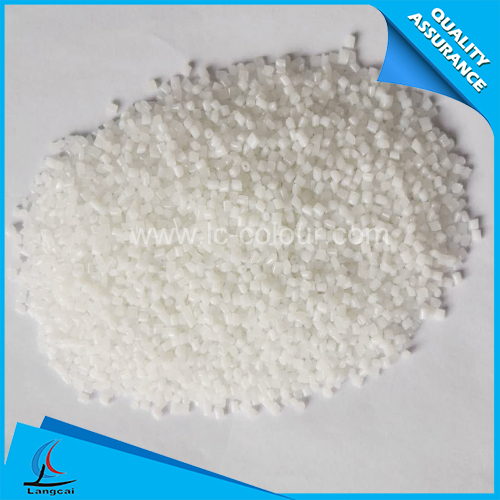
Black masterbatch and white masterbatch are the two major branches of Mono Color Masterbatches. Carbon black type black masterbatch has strong covering power and resistance to migration, and is suitable for outdoor products such as pipes, cable sheaths, and automotive sealing strips. White masterbatch is mainly composed of titanium dioxide and can improve the whiteness and opacity of the products, and is often used in films, sheets, and daily-use containers.
The colorless Mono Color Masterbatch covers the basic color series such as red, yellow, blue and green. During color matching, usually one or two single-color masterbatches are mixed in proportion to avoid color deviation or cost increase caused by the superposition of multiple color masterbatches. Some production enterprises offer customization services, providing color matching and sample-making based on Pantone color numbers or the actual samples provided by customers.
The addition ratio of Mono Color Masterbatch is generally between 1% and 5%. The specific value depends on the pigment content, the thickness of the product, and the covering requirements. For thin-walled products such as films, it is recommended to use high-concentration color masterbatch to control the addition ratio and reduce the impact on mechanical properties. During storage, single-color masterbatch should be placed in a dry and cool place to avoid moisture causing pigment agglomeration or water marks during processing.
- Batch‑to‑batch Color Deviation of Colored Polyester Yarn: Easily‑ignored
- Rapid Pressure Rise of Polyester Spinning Pack: How to Evaluate Dispersion Performance of
- Functional Masterbatch Development for Nonwovens: What Does the New Anti-Slip Technology I
- How Can Mono Color Masterbatch Adapt to Different Plastic Applications? Key Factors from C
- Plastic Processing Shifts to Multi‑variety & Small‑batch Production, Mono̴
- Peak Season for Plastic Processing in Golden Autumn|Yantai Liangcai Plastic Technology Co.
- Spinning Refinement Upgrade Drives Process‑oriented Development of Polyester fiber m
- Polyester fiber masterbatch, Special Coloring Material for Chemical Fiber Dope‑dyein
- Steady Growth in Plastic Coloration Market, Mono Color Masterbatch Expands Application wit
- Custom Mono Color Masterbatch Supplier | Yantai Langcai Plastic Technology